Guide
Cake tin conversion: scale any recipe to your pan
Batter fills a pan by volume, so scaling a recipe between tins is a ratio of their base areas. Multiply every ingredient weight by that ratio and adjust the bake time.
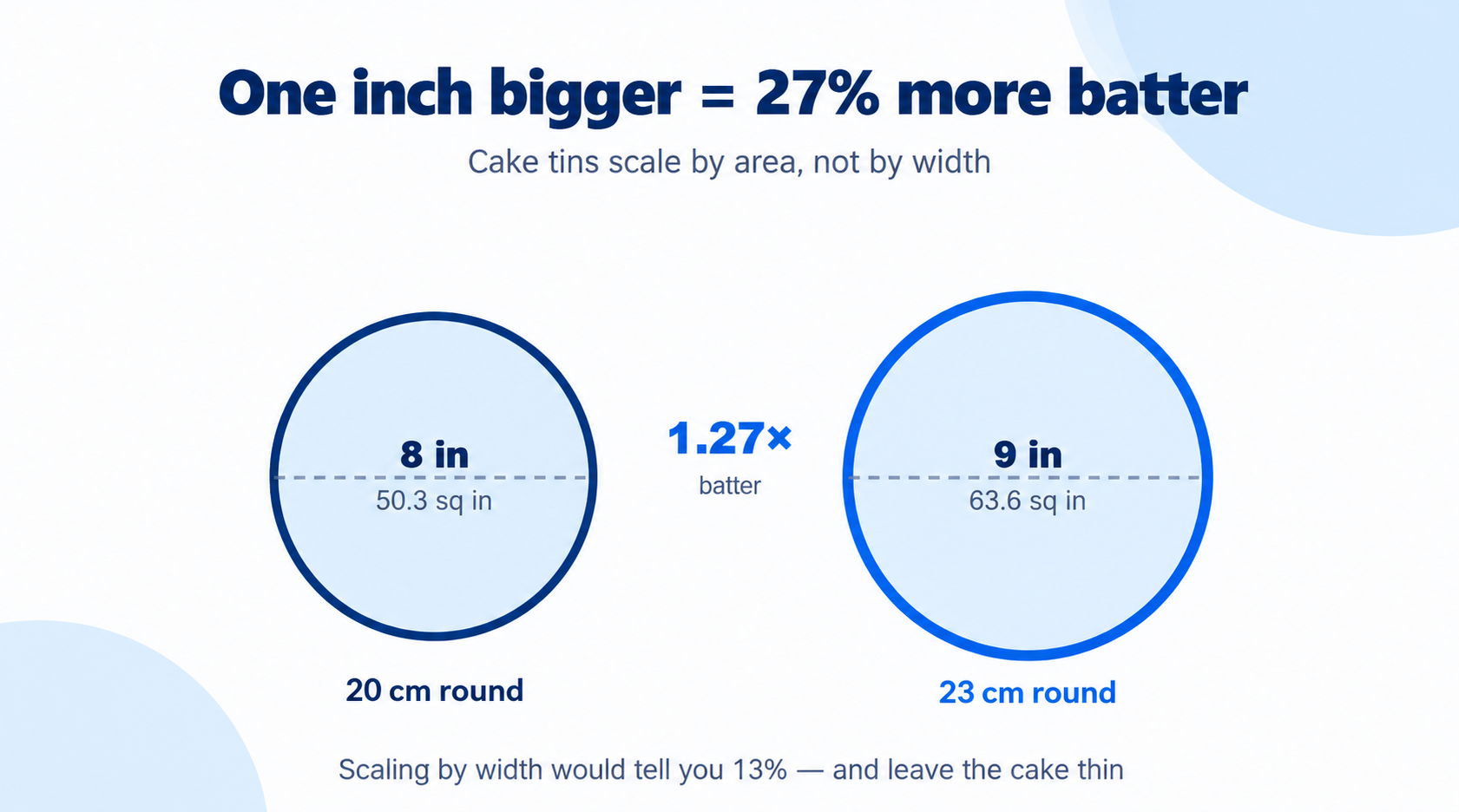
Scaling factors from a 20 cm / 8" round tin
| Target tin | Base area (cm²) | Multiply weights by | Example: 200 g flour becomes |
|---|---|---|---|
| 15 cm / 6" round | 177 | 0.56× | 113 g |
| 18 cm / 7" round | 254 | 0.81× | 162 g |
| 20 cm / 8" round | 314 | 1× | 200 g |
| 23 cm / 9" round | 415 | 1.32× | 264 g |
| 25 cm / 10" round | 491 | 1.56× | 313 g |
| 20 cm / 8" square | 400 | 1.27× | 255 g |
| 23 cm / 9" square | 529 | 1.68× | 337 g |
| 900 g loaf tin | 310 | 0.99× | 197 g |
How to use the factor
- Find the factor for your target tin in the table above.
- Multiply every ingredient weight in grams by that factor.
- Convert the new weights to cups with the grams to cups converter if you measure by volume.
- Keep the oven temperature the same and adjust the time instead.
Adjusting baking time
A wider tin means shallower batter, so it bakes faster: start checking about 20% earlier than the original recipe. A narrower or deeper tin needs longer, and often a lower temperature by 10 °C to avoid a domed, cracked top.
Eggs and leavening
Scale eggs by weight rather than by count (one large egg is about 50 g without shell), and keep baking powder proportional — extra leavening makes a cake rise fast and then sink.